


Cast iron assembly platform
Contact Info
- Add:, Zip: 061000
- Contact: 谢佳宁
- Tel:15350773479
- Email:3622313939@qq.com
Other Products


A comprehensive method for manufacturing large cast iron platforms
The impact of hot sand on mold adhesion in large cast iron platform sand casting: The presence of hot sand causes moisture to condense, thereby affecting the overall mold adhesion effect. Particularly after mold assembly, the hot sand in large cast iron platforms evaporates due to moisture evaporation, causing the condensed sand to adhere directly to the core, which reduces the core's strength and ultimately degrades the quality of the entire casting.
Strict selection of melting furnace charge for large cast iron platforms is required. Rusty, contaminated materials with sand, core 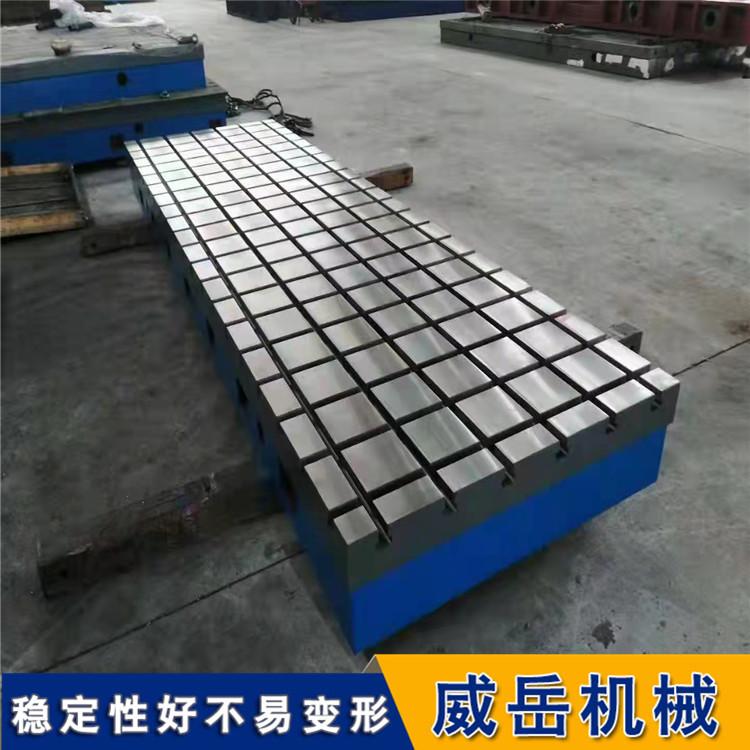 sand, oil stains, and other impurities are strictly prohibited. For the first 6 to 8 melts in a new furnace lining, production should focus on large cast iron platforms with lower carbon content, and carbon-increasing agents are strictly forbidden in the first melt. After the sintering of the new furnace lining is completed, production should commence immediately, with continuous melting for 3 to 5 days to fully sinter the furnace lining. The above precautions are particularly important for extending the service life of the furnace lining in large cast iron platforms.
Large cast iron platforms should be installed level, with the load evenly distributed across all support points. Environmental temperature should be controlled to avoid vibrations during use. The working surface of large cast iron platforms must not have defects such as sand holes, gas holes, cracks, slag inclusions, shrinkage porosity, scratches, impact damage, or rust spots that significantly affect appearance and performance. The influence of friction on the wear rate of scraped contact surfaces: Due to the roughness of solid surfaces, contact between two surfaces occurs only at individual points, resulting in a much smaller actual contact area for large cast iron platforms.
Control of large cast iron platforms: The use of chills can improve the roundness of graphite spheres; the use of chromite sand can also enhance graphite sphericity. Any measures that cool the molten ductile iron during eutectic transformation can improve the roundness of graphite spheres. In retrofitted small foundries, existing dust removal equipment can be utilized, supplemented with new dust collection points and ducts. If new equipment is added, fans with appropriate wind pressure can be selected, with an air consumption of 500 per material cycle for dust removal. Sealed bins should be installed on large cast iron platform sand storage, with suction ports at the top to separate dust during sand flow.
Production of large cast iron platforms using resin sand molds: To reduce costs, the original sand processing system should be modified as much as possible. Horizontal conveyance should use belt conveyors with magnetic separation.
Casting process for large cast iron platforms: Full mold casting and dry mold assembly are used to reduce gas holes and slag inclusions. Mold assembly must meet standards, with multiple risers placed around the pouring gate. After vibration aging of the rough castings (once for rough castings and once after rough machining), the large cast iron platform must support a load of 1000 kg, with a working surface specification of 2500×1000 mm. The material for large cast iron platforms is cast iron HT200-300.
Carefully lower the vibration baseplate equipped with a pneumatic vibrator for large cast iron platforms to the bottom of the electric furnace using a crane. Adjust the air valve to ensure the pneumatic vibrator operates normally, during which the baseplate should visibly strike the bottom furnace lining material. The vibration time for the furnace bottom should be about 10 minutes. During this period, the air pressure should be alternated several times to change the vibration frequency, ensuring uniform compaction of the entire furnace bottom. When lifting the vibration baseplate, operate the pneumatic vibrator at low speed and lift the baseplate slowly and carefully to avoid vacuum suction effects from rapid lifting.
Use a tamping fork to uniformly tamp the furnace bottom four times from deep to shallow. After tamping each layer, loosen the surface of the large cast iron platform to a depth of at least 10 mm before adding the next layer of furnace bottom material. Before tamping the next layer, ensure that any exposed wire mesh is covered with a rubber hose. Continue tamping until the height exceeds the standard furnace bottom dimension by 20–30 mm.
Weiyue Machinery, Ms. Xie, 15350773479
| Industry Category | Hardware & Tools/Castings/Iron Castings |
|---|---|
| Product Category | |
| Brand: | 威岳 |
| Spec: | 2000*4000 |
| Origin: | 111309 |


